
Managing school road safety
Creating safe environments around schools supports student wellbeing and helps families travel safely. Schools play an important role in supervising students and working with families, local councils and other partners to support safe access to and from school.
Parents and carers are responsible for their child’s safety when travelling to and from school.
School's duty of care
Schools must take reasonable measures to protect students from foreseeable risks while they are in the school’s care. This includes:
- before and after school
- during arrival and departure
- off‑site activities closely connected to school (e.g., excursions, travel to TAFE).
Principals determine supervision arrangements based on local context and risk assessment — there is no mandated model.
Teachers may be rostered up to 30 minutes before and after the school day to support safe arrival and departure, and duties must be allocated fairly and equitably.
Schools are not expected to supervise for extended periods outside normal times; however, arrangements must ensure students can safely arrive and depart during the defined supervision period.
Duty of care applies to all staff and extends to any circumstance in which the school has assumed responsibility for students. This includes times when students are entering or leaving the school, moving through car parks or footpaths, or interacting with vehicles in the vicinity of the school.
“Duty of care doesn't stop at the bell or at the school gate.”
“The key consideration is whether a school's supervision plan adequately manages foreseeable risks to student safety during arrival and departure from school”
All advice is taken from the department's Attendance and student supervision fact sheet, refer to Chapter 5 of the Teachers Handbook; Road safety education policy procedures; Duty of care (staff only); Department's Legal Services (staff only); Health and Safety policies and guidelines. (staff only).
To assist schools manage risk and road safety schools can consider using:
- Managing road safety risks assssment resource PDF 318KB (staff only)
This document suggests control measures that can be implemented as part of WHS risk management procedures to reduce road safety risks onsite and in the school traffic environment.
A suggested process to help address a road safety concern.
Principal responsibilities
Principals are responsible for developing, implementing and reviewing the school’s student supervision plan, including arrangements before school and at the end of the day. (as outlined in the Road safety education procedures)
Key responsibilities include:
- maintaining a school road safety risk assessment and management plan
- regularly reviewing safe entry and exit procedures
- sharing current information about before and after school arrangements on the school website and in newsletters
- providing clear information to families about safe travel behaviours and any hazards
- reporting incidents, near misses or unsafe situations promptly using the Incident notification and response procedures
- working with local councils, police, Transport for NSW and School Crossing Supervisors, if relevant
- liaising with Assisted School Travel providers where applicable
- ensuring staff understand arrival and departure supervision processes.
Supervision
When determining supervision arrangements, principals consider a range of factors relevant to the school's context, including:
- Active and purposeful supervision— staff are positioned to observe student movement and respond promptly to emerging risks.
- Consistent with duty of care obligations — foreseeable risks are identified and managed, particularly in higher-risk areas.
- Appropriate to the environment — considering traffic conditions, pedestrian flow, weather, and visibility.
- Clear communication to staff — including expectations for positioning, monitoring and responding to unsafe behaviour.
- Documented procedures — outlining roles, locations and escalation processes.
These factors help determine the most appropriate supervision model for each school.
Pick up and drop off
Schools can help support safe student pick-up and drop-off arrangements before and after school by:
- providing supervision in designated areas where appropriate, such as near crossings, bus areas and pick-up zones
- considering staggered dismissal arrangements where suitable
- communicating clearly with families about supervision arrangements and times
- teaching students safe road use and transport behaviours
- raising identified traffic or road safety concerns with relevant local authorities.
To support students travel before and after school some schools and councils use:
- Kiss and Drop or Kiss and Ride zones, which provide an area on the school side of the road where parents and carers can safely drop off and collect children by car.
- No Parking areas signed as Drop-off and Pick-up zones.
- Park and Walk plans to encourage parents and carers to park away from the school and walk with their child to school.
Some schools use kiss and drop zones before and after school.
Supervision considerations:
- staff working close to moving vehicles
- slips, trips and falls
- manual handling of bags and equipment
- assisting students into vehicles
- visibility during poor weather
- seatbelt responsibilities
- arrangements when supervising staff are absent.
Refer to Transport for NSW for safe drop off and pick up
Managing movement around the school
Schools can support safe and orderly movement around the school through measures that:
- review entry and exit points and pedestrian flow.
- provide clearly identified areas for pedestrians, buses, cyclists and pick-up/drop-off activities where appropriate.
- use signage, numbering or colour coding to identify entry and exit points.
- distribute arrivals and departures across multiple access points where possible.
Supervision considerations:
Staff should:
- remain behind school fencing, or away from road edges, where possible
- avoid standing between vehicles
- wear high-visibility clothing when appropriate
- avoid entering the roadway
- remind drivers to remain stationary until children are safely secured.
School staff, volunteers and parents must not stop traffic or perform the duties of a School Crossing Supervisor.
Only the following people are authorised to stop traffic in NSW:
- NSW Police officers
- authorised traffic controllers
- School Crossing Supervisors.
Supervision considerations:
- wear a high-visibility vest
- use a safe crossing location
- cross students in manageable groups
- ensure students waiting to cross remain in a safe location
- use the "Stop, Look, Listen and Think" process
- hold the hands of young children where appropriate.
Children's flagged crossings
Children's flagged crossings should be used in the same way as pedestrian crossings. Pedestrians must wait until traffic has stopped before crossing.
Staff cannot use the flags to stop the traffic.
Use newsletters, websites, social media, assemblies and signage to communicate:
- changes to entry and exit procedures
- temporary hazards or construction works
- School Crossing Supervisor absences
- public transport disruptions
- pick-up and drop-off expectations.
Risk management resources
To assist schools manage risk refer to these documents:
- Managing road safety risks risk assessment PDF 318KB (staff only)
- Managing risk and a road safety process
- Work, Health and Safety's risk management procedures and fact sheets:
o Lithium-ion batteries - usage, storage and management (PDF 141KB)
o Vehicle on school grounds (PDF 199KB)
o Reasonably Foreseeable Emergencies Summary (244KB)
o Pedestrian incidents advice provided by WHS to mitigate hazards.
The department's Legal Services provides duty of care information in:
- Duty of care and behaviour management - About road safety (staff only)
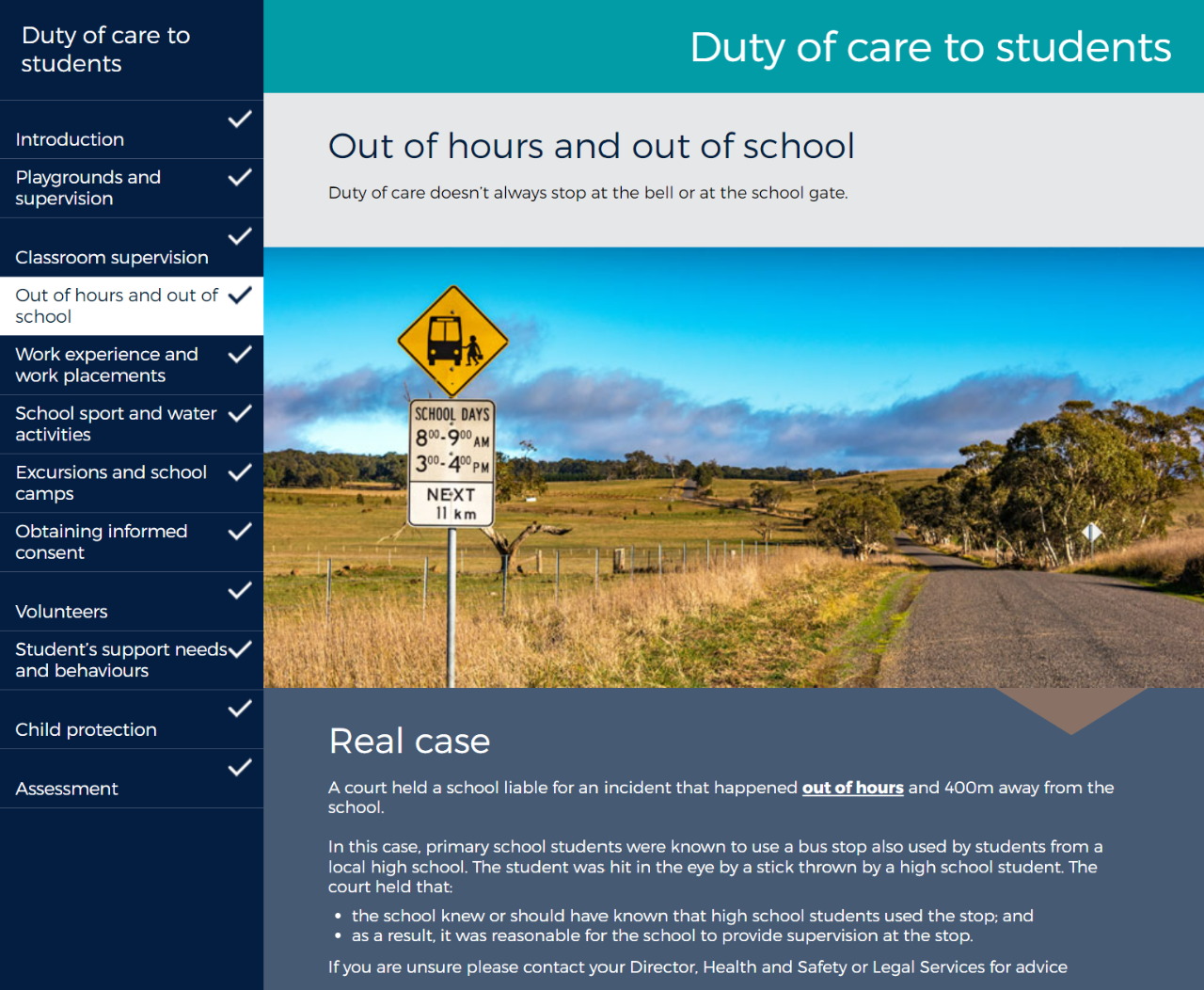
- School leaders and the law (staff only) - an online professional learning module covering 8 key topics. Topic 2. Duty of care to students addresses a school’s obligations for students and road safety in the out of hours and out of school section, as well as travel to and from a workplace program.
Further support for Principals
Last modified date
15/06/2026
Business unit contact email
Executive director
Megan Kelly
Executive director’s business unit
Teaching Learning&Student Wellbeing