
Riding
Parents and carers are responsible for a student's travel to and from school.
Schools play an important role in reinforcing safe riding behaviours by working with families and the wider community. Families influence how students travel and behave on roads, and consistent messages between school and home support safer choices and help build positive habits.
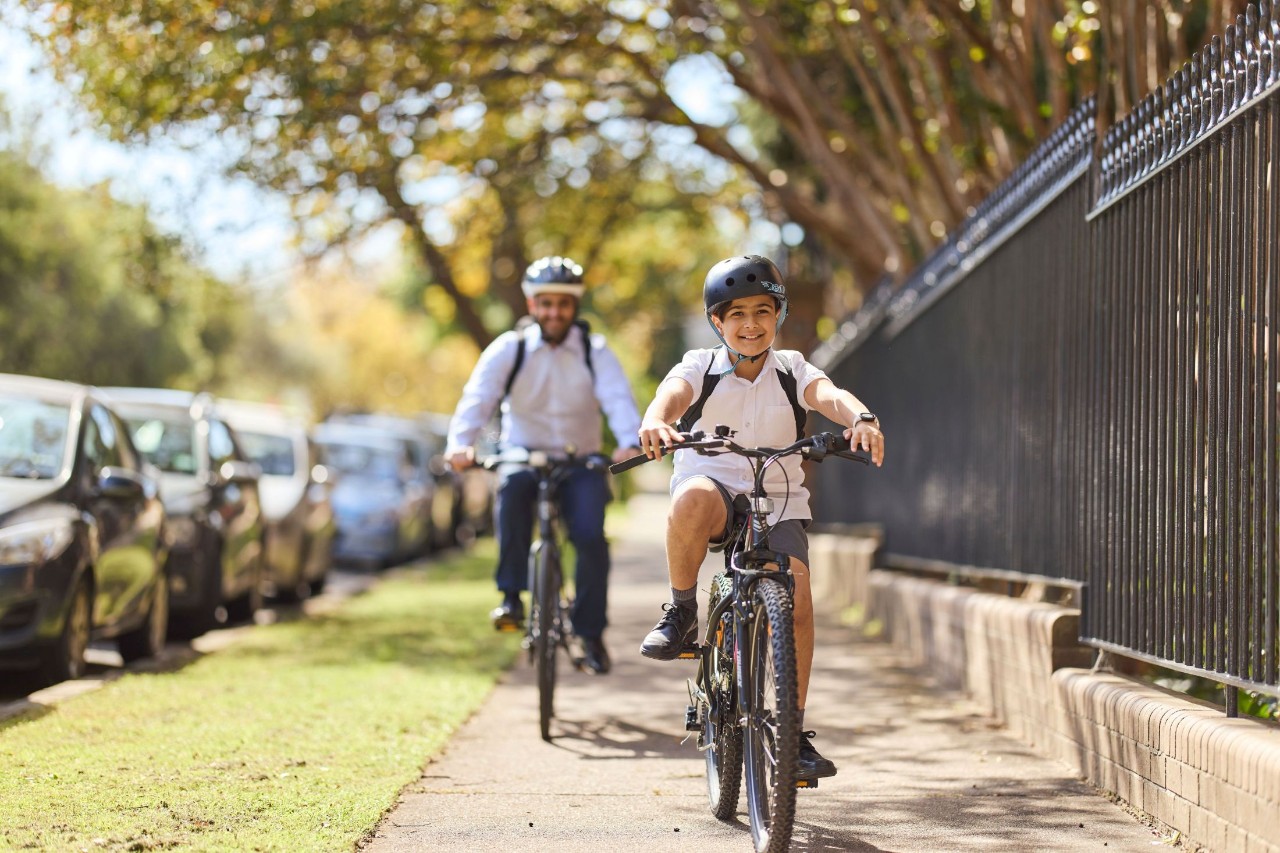
Riding means using any wheeled device—such as bikes, e-bikes, scooters, skateboards or rollerblades—for travel, play or recreation.
Benefits of riding to and from school
- Reduced traffic: fewer cars on the road helps to ease congestion.
- Lower carbon footprint: cycling is an eco-friendly alternative to driving.
- Promotes physical activity: regular cycling keeps students active and healthy.
- Facilitates road safety discussions: provides a chance for supervising adults to discuss road safety with their child.
Safety messages to share with families
- Children under 8 years old should always be supervised and should ride away from busy roads and in safe places such as parks and backyards.
- Children under 10 years old should be closely supervised while riding. Parents and carers should ride along with them on the footpath.
- Children under 16 can continue to ride on the footpath.
- Always wear a correctly fitted helmet.
- Ride a well-maintained bike, e-bike, scooter or skateboard.
- Choose safe places to ride, away from busy roads.
- Stay alert and avoid distractions like phones or headphones.
- Follow the road rules and give way to pedestrians.
- Supervise younger children and ride together where possible.
- Build skills and confidence before riding independently.
Parent and carer advice
Riding safely to and from school (Department's safe travel parent and carer hub)
This page highlights that while riding is a healthy and active way to travel, families are responsible for assessing if it is safe and for supervising younger children. Key messages include wearing a properly fitted helmet, maintaining devices, following road rules, minimising distractions and riding together to build skills and confidence, with increasing independence based on the child’s ability and the safety of the route.
Promoting these messages
Schools can strengthen these messages by working in partnership with families and their local community:
- Share consistent advice through newsletters, school apps and regular communications to families.
- Reinforce messages regularly through assemblies, reminders and school-wide promotion.
- Encourage safe riding habits at home, including appropriate supervision for primary-aged children.
- Provide clear, age-appropriate guidance - for example, children under 16 can ride on the footpath unless signage states otherwise.
- Work with your community to promote safe riding practices that reflect how students travel to and from school.
Resources to support safe riding
These resources can be shared directly with families to reinforce safe riding behaviours at home. They provide practical advice to support safe decision-making when riding bicycles, e-bikes and other wheeled devices.
Resources for newsletters, school apps or direct communication with parents and carers
- Keeping Children Safe in the Road Environment fact sheets (PDF) - TfNSW
- Wearing helmets and riding safely
- Translations available
- Information for parents and carers about safety on wheels (PDF) - TfNSW
- Safety town - safe riding -(advice for families) - TfNSW
- Information for travelling independently as a rider advice for students and their families (DoE)
E-bikes and e-scooters
E-bikes are becoming increasingly popular, and schools, parents and carers must be informed about the relevant laws, rules, and regulations governing their use.
- E-bikes advice for families (PDF) - TfNSW
- E-scooter advice for families (PDF) - TfNSW
- Buying and maintaining your bicycle or e-bike
Resources to reinforce key safety messages about riding safely and following road rules
- Safety and rules for bicycle riders (Service NSW)
- Cyclists advice - TfNSW
- Safety while riding advice - TfNSW
- Sharing the road with bicycles (video) - TfNSW
- Quad bike safety - advice Safework NSW
Last modified date
01/07/2026
Business unit contact email
Executive director
Megan Kelly
Executive director’s business unit
Teaching Learning&Student Wellbeing