
Chunking and sequencing learning
Teachers break information into manageable chunks and present it in a logical sequence with frequent opportunities for students to practise.
Chunking and sequencing learning is an explicit teaching strategy. It involves chunking learning into manageable components to reduce demand on students’ working memory. Sequencing those chunks in a logical progression supports students to incorporate new information into their mental model, or schema (AERO 2024).
When learning is new, students have limited capacity to compute more than a few pieces of new information. Teachers select pieces of information to introduce together. Practise allows students to consolidate this learning into a schema in their long-term memory. When it is retrieved from long-term memory as a schema it takes up less space in the working memory. Teachers sequence the next pieces of learning to add to the schema. This is how students can learn highly complex concepts (AERO 2022).
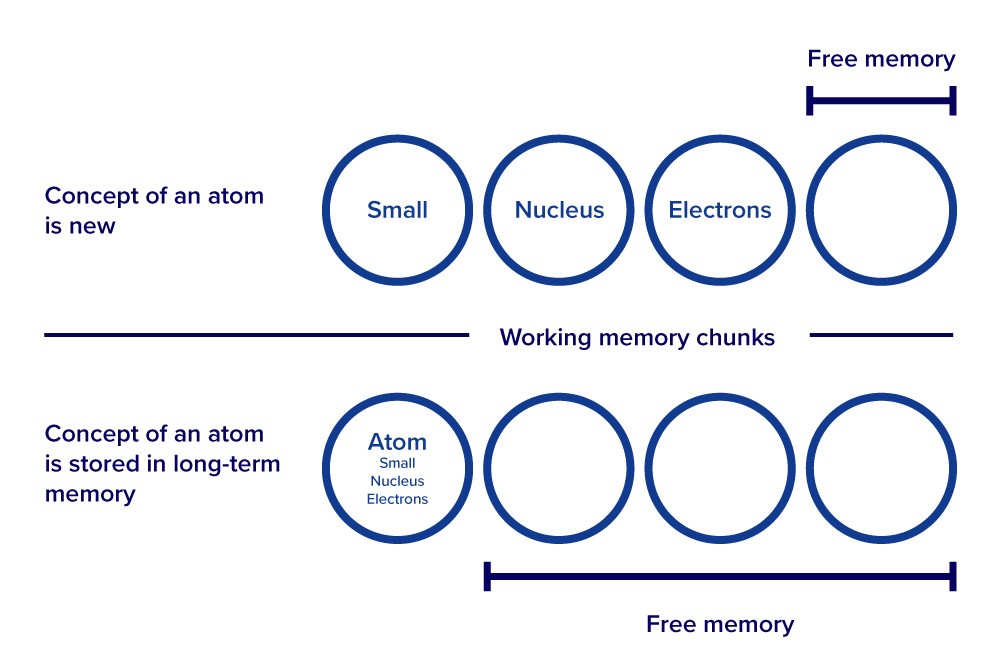
Image adapted from Australian Education Research Organisation Limited (AERO) (2023) Explicit instruction and licensed under CC BY 4.0.
Video – Chunking and sequencing (3:15)
Trying to learn everything at once can become overwhelming. But when complex learning is broken into smaller parts and introduced in a logical sequence, it becomes easier to learn.
This animation explains how chunking and sequencing can support learning.
It outlines how chunking and sequencing:
- introduces new concepts and skills into manageable chunks based on students’ prior knowledge and learning needs
- gives teachers opportunities to check for understanding and adjust teaching between chunks
- sequences learning so that new knowledge and skills build on what students already know
- works with other explicit teaching strategies, such as checking for understanding.
The animation can be used:
- to strengthen a shared understanding of chunking and sequencing
- as a stimulus for discussions about how chunking and sequencing supports accurate schema development
- to support professional learning about chunking and sequencing and how it aligns with how students learn and cognitive models of learning.
Narrator
[Text on screen reads, Chunking and sequencing.]
Have you ever tried to learn something new? Maybe you've learned to play an instrument or follow a new recipe. Trying to learn everything at once can become overwhelming. But when complex learning is broken into smaller parts and introduced in a logical sequence, it becomes easier to learn. Each small success builds the knowledge, skills, understanding and confidence needed to reach the bigger goal.
The same is true for students when too much new learning is introduced at once. It can overwhelm their working memory. As teachers, we can support students by chunking and sequencing learning. This explicit teaching strategy breaks new learning into meaningful, manageable chunks and organises them in a logical order.
The size of each chunk will depend on the complexity of the learning, student's prior knowledge, and the needs of the class or the group. Chunking isn't about dividing outcomes or content points into activities. Instead, it involves breaking down new concepts and skills into manageable components in ways that supports student learning.
Think about learning to cook scrambled eggs. For our students with prior knowledge, making scrambled eggs may feel effortless because they have a well-developed schema that organises and connects knowledge and skills.
[Screen shows a mind map showing the knowledge and skills needed to cook scrambled eggs with the words safety and hygiene, care with hot surfaces, handwash, protective clothing, role of ingredients, eggs, milk, salt, measurement, teaspoon, tablespoon, millilitres, techniques, whisk, fold, heat and temperature]
A student new to the learning may still be developing their schema. They may first need to understand key concepts such as the role of ingredients, how quantities are measured, how mixing changes the structure of eggs and how heat affects the cooking process.
In some cases, students might need us to break these concepts down even further, depending on their prior knowledge and experience.
[Screen shows mind map with the words safety and hygiene, role of ingredients, measurement, techniques, changing structure, whisk, fold and heat]
There is no one way to chunk or sequence learning,
[Screen shows teacher sitting at a desk with two thought bubbles, one with the words “what knowledge, skills and understanding do my students need? The other speech bubble has the words role of ingredients, measurements, changing structure and heat]
and by teaching in chunks that suit our students, we work within the limits of our students' working memory, helping manage their cognitive load.
Checking for understanding between chunks gives us feedback on student learning.
[Screen shows teacher standing at the board with a speech bubble above her head, the speech bubble has the words “why do we whisk eggs?”. Animated speech bubbles appear above students who are sitting in front of the board, answering the question all together. The speech bubbles above their heads read “mix, aerate and aerate]
This enables us to adjust our teaching to support the development of accurate schema by moving onto the next chunk of learning or reteaching with further modelling, extra examples, or added scaffolding.
[Screen shows a flow diagram that splits into 2 arrows representing a decision point for teachers. One arrow curves upward, labelled ‘Plan A: Move onto the next chunk of learning’. The second arrow curves downward, labelled ‘Plan B: Reteach with further modelling, extra examples or added scaffolding’.]
Working in partnership with chunking, sequencing involves arranging chunks in an order that makes sense for the learners, linking new learning to what students already know. Unit planning is also about sequencing, but on a bigger scale.
[Screen shows a table with the heading syllabus outcomes and the words prior knowledge, key knowledge, connected ideas, misconceptions and responses and vocabulary.]
It's about organising learning across a series of lessons or units to ensure a coherent progression.
When done well, sequencing helps students build accurate and increasingly complex understanding.
[Screen shows a mind map coming from a student’s head with the words safety and hygiene, care with hot surfaces, handwash, protective clothing, role of ingredients, eggs, milk, salt, measurement, teaspoon, tablespoon, millilitres, techniques, whisk, fold, heat and temperature]
So why chunk and sequence learning? Because it helps us work within the limits of working memory while supporting understanding, confidence and success. To learn more about chunking and sequencing, please visit the Explicit Teaching Strategies site.
[Screen shows a URL: https://edu.nsw.link/explicit-teaching-chunking-and-sequencing]
[End of transcript]
Strategy learning module
The Chunking and sequencing strategy learning module (PPTX 9.8 MB):
- breaks down the strategy
- shows how the strategy can be applied using different techniques
- offers professional learning support for a whole-school approach to explicit teaching.
More information about how to implement this professional learning can be found on Leading explicit teaching.
Technique guides
Explicit teaching strategies are implemented in the classroom through a range of techniques intentionally selected by the teacher. These techniques are not an exhaustive list of every approach a teacher may use to implement this strategy. These technique guides provide support to teachers to understand and apply the technique as part of their explicit teaching practice:
What it isn’t
- Chunking and sequencing activities rather than chunking and sequencing knowledge and skills.
- Using existing programs, units or lesson plans without responding to evidence and data about your students.
- Moving on to new information without checking for accurate understanding from students.
- Reducing the expectations for students when learning is new and complex.
Note: The explicit teaching strategy of chunking and sequencing is not the same as creating a scope and sequence document. Information on the requirements for a scope and sequence can be found on NESA’s Advice on scopes and sequences.
Further resources
- AERO (Australian Education Research Organisation) (2024) Teach explicitly.
- CESE (Centre for Education Statistics and Evaluation) (2017) Cognitive load theory: research that teachers really need to understand.
AERO (Australian Education Research Organisation) (2022) Explicit instruction, AERO, accessed 16 April 2024.
AERO (Australian Education Research Organisation) (2024) Explicit instruction optimises learning: Implications for policymakers, AERO, accessed 18 April 2024.
Last modified date
05/11/2026
Business unit contact email
Executive director
Megan Kelly
Executive director’s business unit
Teaching Learning&Student Wellbeing