
NSW Aboriginal Languages Week 2026
NSW Aboriginal Languages Week 2026 runs from 18-25 October. It is a time to celebrate and honour the ongoing work of Aboriginal communities to reawaken, grow and nurture Aboriginal Languages and cultures.
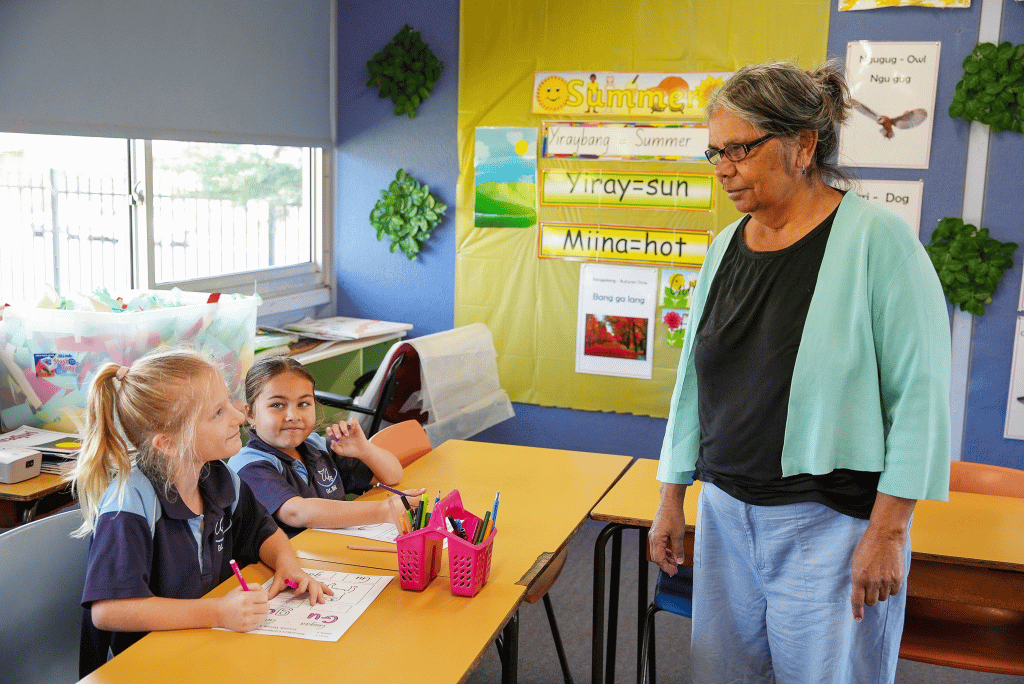
Join us in celebrating NSW Aboriginal Languages Week by participating in Aboriginal Language and Culture learning, connecting with local Aboriginal communities and supporting community led efforts to reclaim, revitalise and strengthen Aboriginal Languages for future generations.
The NSW Department of Education recognises the importance of NSW Aboriginal Languages Week and our ongoing commitment to the reclamation, revitalisation and celebration of Aboriginal Languages across all educational settings.
Supporting Aboriginal Language learning, under the guidance and authority of local Aboriginal communities, strengthens cultural identity and deeper connections between schools, early learning services, families and Aboriginal communities. This work enriches our education system, benefits all students, families and staff, and supports the commitments of the Aboriginal Education Policy.
‘Living Languages, Strong Futures’
This year’s theme ‘Living Languages, Strong Futures’ acknowledges Aboriginal communities across NSW who are leading the way in keeping Languages strong through learning, sharing, teaching and speaking Language every day.
During NSW Aboriginal Languages Week, we celebrate this continuing work and look ahead to a future where Aboriginal Languages continue to grow, thrive and are passed on to future generations.
We also honour the courage, strength and resilience of Aboriginal families and communities who, despite past government policies, continued to carry and pass on language through generations often at the risk of facing punishment. Today, our languages are living and strong because of them.
Video resources
The NSW Department of Education, in partnership with the NSW Aboriginal Education Consultative Group Inc. (NSW AECG), has developed videos to inspire, excite and support national efforts to revitalise Aboriginal Languages.
Video 1: Welcome to NSW Aboriginal Languages Week
Hear from Murat Dizdar, Secretary at the NSW Department of Education, and Raymond Ingrey, President of the NSW AECG, as they come together at La Perouse Public School to launch NSW Aboriginal Languages Week 2026.
Students singing in Dharawal Language
Walanja walanja mudjari djanbay dharagangdha, nandayibi yanaga buwindja garuga yagay. (Row, row your boat gently down the stream, if you see a shark don’t forget to scream).
Murat Dizdar
Hello everyone, it's Murat here.
We're coming to you from the beautiful homelands of the Bidjigal clan who are the Ongoing Custodians of Country here at fantastic La Perouse Public School.
We would like to acknowledge and pay our collective respects to Elders past and present as ongoing teachers of knowledge, song lines and stories, and we want to extend that respect to all Aboriginal and Torres Strait Islander people and colleagues and communities across NSW.
Today, I've got the great privilege of being with our students under the watchful eye of our NSW AECG President in Ray Ingrey.
Ray Ingrey
Thank you Murat.
I'd also like to acknowledge our old people who've come before us and acknowledge Country on where you're celebrating Aboriginal Languages Week.
Aboriginal Languages Week in New South Wales recognises the passing of the Aboriginal Languages Act in 2017.
The Act acknowledges the significant role Aboriginal Languages has to the identity and belonging of Aboriginal people across NSW.
Murat Dizdar
We're deeply proud that this year marks the fourth year of celebrating NSW Aboriginal Languages Week.
This year's theme is very apt, “Living Languages, Strong Futures”.
Here at La Perouse, students are learning Dharawal language from Dharawal people using in their daily lives and now passing that knowledge on to the next generation.
We're proud of our partnership with the Gujaga Foundation and here at La Perouse Public School, their Language and Culture program.
It's by learning, speaking and sharing the Dharawal Language that our students are helping to ensure that it remains strong, vibrant and thriving for future generations.
La Perouse is a fantastic example of the incredible language learning and sharing that's taking place in schools across NSW.
Male Language Educator
Manda warrigal (grab the dingo)
Budjari (good job).
Biinyanaga manda garri. (Don’t grab the shark, grab the snake.)
Budjari (good job).
Mandagayanbudjaan mandabiingarri manda yanaga. (Grab the big bird, don’t grab the snake, grab the shark.)
Female Language Educator
Mingang nhay? (what is this?)
Students
Djungaa (octopus).
Murat Dizdar
Djungaa (octopus).
Female Language Educator
Djungaa (octopus).
Female Language Educator
Mingang nhay? (what is this?)
Students
Djamalang (platypus).
Murat Dizdar
Djamalang (platypus).
Female Language Educator
Budjari (good job).
Ray Ingrey
Throughout the week, we will highlight a series of videos made in partnership between the Department of Education and the NSW AECG.
It starts here today with Murat and myself at La Perouse Public School, my old public school and then we'll see other videos, including students from Dubbo North School on Wiradjuri Country sharing language, songs and culture with students across the state, greeting each other in their Language.
And then we'll head to Gumbaynggirr Country where Micklo Jarrett will take us through a tour of Bush Tucker and Bush medicine plants that are significant to Gumbaynggirr people.
Student
Mingang nhay djamalang (What is this platypus?)
Murat Dizdar
Djamalang (platypus)
Student
Mingang nhay? (What is this?)
Murat Dizdar
Tortoise?
No, no. What did it start with?
Student
B.
Murat Dizdar
B?
Murat Dizdar
OK, help me.
Student
Bilima! (fresh water turtle)
Murat Dizdar
Bilima. (fresh water turtle)
Murat Dizdar
We deeply respect Aboriginal Languages, we are firmly committed to their revitalisation, and we're not going to be shy in celebrating and keeping strong language learning for generations to come.
Video 2: Wiradjuri Rap
Feel the beat of Wiradjuri Country! Students and staff from Dubbo North Public School come together to celebrate language and culture through an energetic rap.
Student (talking)
Yiradhu Marang Yuwin-dhu Arlie.
Ngadhu banhi-gu gulbarra Wiradjuri Mayiny-galang ngan.gu ngurambang-ga Nginha ngan.girra dhurinya gayi.
Mandaang guwu
Hello, I'm named Arlie Fernando.
I'd like to acknowledge Wiradjuri people whose traditional country this project is being held.
(Music starts)
I would also like to pay respect to Elders past, present and emerging here today.
Thank you.
Student 1 (rapping)
Gawaymbanha-dhu Dubbo North,
Where me and my mudyi Learn together, of course.
We speak our language and we speak it with pride
Ginhar-girri starts with you and I.
Student 2 (rapping)
We listen to Elders and stories they share.
The words of our ngurambang are everywhere.
In the classroom, playground, out in the sun.
Learn together makes culture strong.
Student 3 (rapping)
We listen to stories and know what they mean,
about ngurambang, culture and places we’ve seen.
We learn from our teachers, Elders and friends
and say the words over and try them again.
Student 4 (rapping)
Stand up together, let everyone hear
Wiradjuri language is living right here.
Dubbo North students, proud as can be,
Ginhar in our culture and identity.
Chorus (students sing together)
Ngiyanhi-dyi Dubbo North-dha
We are the kids from Dubbo North,
Wiradjuri ngurambang
On Wiradjuri Country.
Yalibilinya ngumbadal
We learn language in unity
Ginhar-girri wamarra miya
Strong futures built together
Oh, oh oh Ginhar-girri wamarra miya
Oh, oh oh Strong futures built together
Ngiyanhi-dyi Dubbo North-dha Wiradjuri ngurambang
We from Dubbo North, On Wiradjuri Country.
Student 1 (rapping)
Fill the breeze through the trees, hear the birds when they call.
See the bila still moving. Country teaches us all.
There are stories in the soil, there's knowledge in place.
There's pride in our language and a smile on each face.
Student 2 (rapping)
We might come from different families and homes.
We learn side by so no learner’s alone.
With yindyamarra in our voices and pride in our chest.
We honour Wiradjuri and ive it our best.
Student 3 (rapping)
We Winhanganha the Elders who carried it through.
So the words stayed alive for me and for you.
We are young, but together our message is clear.
Ginhar-girri are growing and starting right here.
Student 4 (rapping)
From the past to today, let the old word ring,
in the game that we play and the songs that we sing.
Dubbo North students, together and proud,
Keeping language living by speaking it loud.
Chorus (students sing together)
Ngiyanhi-dyi Dubbo North-dha
We are the kids from Dubbo North,
Wiradjuri ngurambang
On Wiradjuri Country.
Yalibilinya ngumbadal
We learn language in unity
Ginhar-girri wamarra miya
Strong futures built together
Oh, oh oh Ginhar-girri wamarra miya
Oh, oh oh Strong futures built together
Ngiyanhi-dyi Dubbo North-dha Wiradjuri ngurambang
We from Dubbo North, On Wiradjuri Country.
Learn it!
Yalibilinya
Speak it!
Yarra
Keep it!
Ngiilinya
Strong!
Ginhar
Listen!
Wudhargarbinya
Respect it!
Yindyamarra
Chorus (students sing together)
Ngiyanhi-dyi Dubbo North-dha
We are the kids from Dubbo North,
Wiradjuri ngurambang
On Wiradjuri Country.
Yalibilinya ngumbadal
We learn language in unity
Ginhar-girri wamarra miya
Strong futures built together
Oh, oh oh Ginhar-girri wamarra miya
Oh, oh oh Strong futures built together
Ngiyanhi-dyi Dubbo North-dha Wiradjuri ngurambang
We from Dubbo North, On Wiradjuri Country.
Students together
Wiradjuri language is living right here,
Dubbo North students proud as can be!
Video 2: Resources
Video 3: Gumbaynggirr Bush Tucker Walk
Step into nature and culture on a Gumbaynggirr bush tucker walk with a Gumbaynggirr Elder, Uncle Micklo (Michael) Jarrett, as he brings stories and connection to life.
Uncle Micklo Jarret
This is the land of the Gumbaynggirr people. My ancestors have lived here for thousands of years.
They've watched this ocean and they've got dreaming stories of the sea level rising.
Today I'm going to take you around and show you some of the bush foods that we have on Gumbaynggirr homeland.
Giinagay ngujawiny. Darruyay yilaaming Gumbaynggida jagunda.
Hello everyone. Welcome to Gumbaynggirr homeland.
Yaam ngaya Gumbaynggirr jaanybarr. Yaam wajaarr Gumbaynggirr waw.
I am a Gumbaynggirr man. This land is Gumbaynggirr also.
Darruy ngujalinya nyaagaygu.
Good to see you all.
Ngiyambandi wajaarr-biin yarraang jaagi gurraygu.
Our homeland is sacred to all.
Baya maangu nginumbala yidaa, yidaa, yidaa.
May my ancestors protect you always, always, always.
And I'd like to pay my respects to my ancestors who have lived on this land for thousands of years. I'd also like to pay my respects to your Country, to your ancestors, and to all the people of your homeland.
But first of all, I'll do a smoking ceremony.
Bigaa yi yaarri juumbu, darruy maani yaarri juumbu.
Smoke take away the bad energy. Smoke bring good energy.
Ngaya maraal-gundi. I belong to the earth.
Ngiyaa maraal-gundi. We belong to the earth.
Jaaningga. Wattle tree.
Guuray. Flower.
Jaaningga. Guuray. Jangguurr (leaf).
So, when they made the fish traps for the fish, everyone would get these leaves and make this foam. This foam would take the oxygen out of the water and the fish would then come to the surface.
So, this was a very, very, very important tree.
This tree, from the leaves, made the foam, also good for antiseptic.
The flowers told us that the fish, called the warraagan, the luderick, were starting to come. So they start to prepare these traps to trap all the fish.
I've been holding onto this branch for a while now, and I'm making a connection with me and this tree.
It feels good. I don't want to let it go, but I'm going to let it go to show you a few things that the Gumbaynggirr people knew about this tree.
One of the things about the tree, underneath the green leaf is a white. If you look at that tree up there, it's now showing its underbelly. It's showing the white part of the leaves.
And when Gumbaynggirr people saw that, they knew that rain was coming. Another thing about this, is this thing.
When this is just in flower and it's beautiful and it's just started, there's a lot of nectar in this. So, we got our beautiful, beautiful, sweet taste from this tree.
Inside this, if you peel all this back, it's still a little bit green and you break that off.
When you light this at a fire, this burns really, really, really slow.
So, if they're going to move a camp, they would put that in there like that and go, because it's already got the ash. And then they start to fire like that.
This plant had multiple uses as well. The leaves were stripped for making weaving baskets and stuff but also before they do that you can chew the end of this so it's like a celery. But after they finish chewing it, they would strip it back like that and then they have long pieces to start their weaving. They would dye it and then start their weaving.
Seeds off the lomandra plant. They used to make bread out of it, but it's also yummy just to eat like that. Yum. That is a good taste.
So that plant was abundant in this area and when it was seeding and flowering like that, then all the people would gather all the seeds in a thing called a coolamon. And then they'd crush it up and put some water on there to make a dough, a paste and then put it in the coals and make bread.
Darruy wunba. Very good.
Long ago in the dreamtime, there was this man, very handsome and very strong, long dreadlocks. He had this huge boomerang, silver. He used to paint it up with this white ochre. Every day he used to polish, polish, polish, polish his big boomerang. And every time he threw his boomerang, it used to come back every time. This was way back in the dreamtime, when there was no moon.
So, this guy called Birrugan, strong, handsome man with long dreadlocks, used to throw that boomerang, catch it every time.
One day he threw it that hard, whooshka. He waited and he waited and he waited. The boomerang didn't come back.
He was so sad. He went looking for it everywhere. In the waters, in the trees, under the grass. All day he looked for it. He gave up and he went home, made a fire, laid down on his kangaroo skin. And later in the night, he saw this thing up in the sky. Big silver thing shaped like his boomerang. And he looked and said, hey, that's my boomerang.
That's how the moon come to be in the sky. Because this young man, Birrugan threw his boomerang and it stayed up in the sky and it went around and around the sky.
And that's how the giidany come into our world.
Video 4: Greetings in Aboriginal Languages
Listen to students across NSW showcase greetings in local Aboriginal Languages and highlight the rich diversity of languages in NSW.
Kyeema (Bundjalung)
Hello, my name is Kyeema Close.
I am Bundjalung.
I am from Casino.
Who are you?
Q’Nari (Wiradjuri)
Yiradhu marang!
Day Good!
Yuwin ngadhi Q’Nari.
My name is Q’Nari
Ngadhu Wiradjuri Dhubu-dhi.
I am Wiradjuri from Dubbo.
Ngindhu nganha?
Who are you?
Kyron (Gathang)
Wiyabu!
Hello!
Ngatha yitirr Kyron.
My name is Kyron.
Ngataha biripi guba.
I’m Biripi
Ngatha yalawyn Dungogga.
I live in Dungog.
Ngaana biyay?
Who are you?
O’shea (Dhanggati)
Yawayi, Dhanggu nyuwayi O’shea
Hello, my name is O’shea.
Ngaya Dhanggati.
I am Dhanggati.
Ngaya Gimbirriyakayi
I am from Kempsey
Ngaanang nyinda?
Who are you?
Darruy (Gumbaynggirr)
Nganyundi bijaarr Darruy.
My name is Darruy.
Giinagay, ngaya yaam Gumbaynggirr.
Hello, I am Gumbaynggirr.
Ngaya yaam Baga-baga nyarr.
I am from Nambucca.
Waarru yarrang ngiinda?
Who are you?
Martin (Awabakal)
Ela Martin yiterabulbaang.
Hello, my name is Martin.
Ngatowa Awaba Barai, Kaleynbaang.
I am from Awabakal Country.
Ngaankebi.
Who are you?
Ashar (Gomeroi)
Yaama, gayrr ngaya Ashar.
Hello, my name is Ashar.
Gomeroi ngaya, Tamworth-dhi ngaya.
I am Gomeroi, I am from Tamworth.
Ngaandi Nginda?
Who are you?
Nicki (Awabakal)
Ela Nicki yiterabulbaang.
Hello, my name is Nicki.
Ngatowa Awaba Barai, Kaleynbaang.
I am from Awabakal Country.
Ngaankebi.
Who are you?
Bonnie (Awabakal)
Ela Bonnie yiterabulbaang.
Hello, my name is Bonnie.
Ngatowa Awaba Barai, Kaleynbaang.
I am from Awabakal Country.
Ngaankebi.
Who are you?
Jaz (Paakantyi)
Yirlayi, ngayi, kiirintya.
Hey, Hello, I'm here to show my respect.
Nhiiki nguma Jaz mininititya-ntu ngiyampaa, paakantyi tha.tha nguungku.
My name is Jaz a ngiyampaa, paakantyi young woman from Menindee.
Wiintyakimpa?
Who are you?
Video 5: Gamilaraay Language Learning for Early Childhood learners in Gunnedah
Every word spoken is an opportunity for Language to be heard, shared and passed on.
Through the Ninganah No More program, local Aboriginal educators share Gamilaraay Language with children at Winanga-Li Early Learning & Care Service in Gunnedah, supporting connection to culture, family, Community and Country.
Learning Language from an early age strengthens connection to culture, family, Community and Country, while supporting Language being shared across generations.
Vanessa, Renee and participants (spoken together)
Here is the sky, marliyanali, marliyanali, here are my friends, here are my friends, nganali, nganali, and here am I, here am I. We thank the Gamilaraay people, for the land on which we learn and play, mara up, mara down, we are on Gamilaraay ground.
Renee
It's so important to me and it's a passion because we get to share it to our younger generation. The most exciting thing now is that we can teach from zero to five years. So, these younger children are now speaking language and they're sponges, so they're picking it up a lot more than what older people are.
Vanessa
The guya looked up at the gunagaala sky yiluwidi, said the guya yiluwidi.
Here at Winanga-Li, we are funded by the Ninganah No More program. So, our job is to go into the preschools and the daycare centres and teach all the little ones Gamilaraay language, which is really lovely.
Wayne
Our mission is to create strong children, strong families and in turn strong communities, and we see language as a crucial component of that. To support children to understand their language, helps children to develop a stronger identity in who they are, and a stronger connection to their Aboriginality.
Vanessa
You know, the words, the Gamilaraay words just have so much meaning more than translation, so it really solidifies that it's a calling, you know, you've got to go out there and you've got to educate these children and these people and just respectfully teaching it.
Aaron
What I'm starting to see is our little ones learning their language, learning their culture, passing that language and culture on to their families. It helps keep language culture strong and, you know, we'll hopefully set for future generations.
Kara
So, the value of the localised approach for Ninganah No More is that it's designed by local communities. So we have local Aboriginal language teachers coming into early learning settings and delivering language on Country to our littlest learners.
Aaron
Each service can provide language and culture the way that they best see it, suiting their little ones, their communities, their families. They bring in local Elders, they bring in local people that know their language and are knowledge holders.
Kara
It's a grants process and it's a four-year funding cycle. So early learning centres are able to apply for the funding through the Department of Education.
Aaron
It's super important ensuring that our communities have control over sharing their stories, sharing their language, sharing their culture.
Renee
Living Languages, Strong Futures is what we do. It is teaching children language, living it and sharing it to the next generations, and that is exactly what it is all about, this year's theme.
Vanessa
Next, an orange balabalr flew over the guli water. “bambul, bambul, said the guya. Can you say that? bambul, bambul. Wow.” I would love to see my grandbabies speak it. I would love to see it being taught fluently in schools and daycare centres and around the community and just seeing people speak it to each other, even if it is a few words, you know, it doesn't have to be sentences, just something.
Renee
Although we go in and teach children, we're also teaching the room leaders in the room to embed it when we can't be there. That's why it's important, they more they're hearing it every single day, it won't get forgotten and that's what's so important that we won't lose language again.
Child singing in language
guwaymbarra, gidjirrgidjirr, gawarrawarr, bibubibu, bambubambu, yiluwidi, yuluwirri
Renee
My hope is that we keep doing this. It's all of our team's passion is to keep learning and keep sharing. My dream is that you can walk down the street and kids are speaking sentences and it's hardly any English. I know it won't be like, just yarning in language.
Vanessa
Can you give it to Miss Ness? Yaama maliyan
Embed Aboriginal Languages and Culture in classrooms and learning
NSW Aboriginal Languages Week is an opportunity to embed language learning into classroom lessons, activities, events and school programs.
- Use our NSW Aboriginal Languages Week videos and resources to embed Aboriginal Language and Culture learning into classroom lessons and activities.
- Work with your Local AECG, local Aboriginal community, Elders and appropriate Language knowledge holders to ensure local Language and Culture are incorporated into teaching and learning in ways that respect local community authority and protocols.
- Engage Elders, Aboriginal community members and language and knowledge holders to share stories, words and cultural knowledge with students.
- Encourage students to explore and celebrate their cultural identity through language projects across subject areas.
- Support Aboriginal and Torres Strait Islander students in leading language initiatives and sharing their voices.
- Promote family and community involvement in language learning to strengthen intergenerational connection.
Cultural principles and protocols
When it comes to teaching and learning Aboriginal languages and culture, schools must work in partnership with their local Aboriginal communities, in line with local cultural principles and protocols.
In NSW, cultural principles and protocols may differ between local Aboriginal communities. Schools should adhere to these principles and protocols when sourcing local Aboriginal language speakers and throughout the development and implementation of school-based learning and teaching programs to maintain and revitalise local Aboriginal languages and cultures.
To learn more about local cultural principles and protocols, schools are encouraged to contact their:
Local Aboriginal Education Consultative Group (AECG),
Aboriginal Languages and Cultures team in the NSW Department of Education
Aboriginal Language and knowledge holders and/or Aboriginal Language Centres.
You can also visit the NSW Education Standards Authority (NESA) website to download the Aboriginal and Torres Strait Islander principles and protocols.
For more information read the Cultural Protocols for teaching Aboriginal Languages and Cultures fact sheet from the NSW AECG.
Get involved
Share your Aboriginal Languages Week celebrations
Share how your school, early learning service, or workplace is celebrating NSW Aboriginal Languages Week on Viva Engage by using #NSWAboriginalLanguagesWeek #LivingLanguagesStrongFutures, or on social media by tagging @NSW Department of Education.
Download Teams background
Help spark conversations by downloading and using the NSW Aboriginal Languages Week 2026 Teams backgrounds. It’s a small but visual way to show your support for Aboriginal Language revitalisation in our schools, early learning services and across the department.
Start your school’s language revitalisation journey
Connect with your Local Aboriginal Education Consultative Group (AECG) or Language groups to learn how you can support language revitalisation in your school. You can also contact our Aboriginal Languages and Cultures team for information, resources and support to help your school embed Aboriginal Language and Culture into teaching, learning and school-wide programs. Email the team at AboriginalLanguagesAndCulturesCorro@det.nsw.edu.au.
Join the conversation
Everyone is welcome to join the Aboriginal Education community on Viva Engage and Statewide Staffroom. It is a great way to join the conversation about Aboriginal Languages and Cultures in our schools and early learning services.