
Research and policy
MSMW fills an equity gap for students who have not previously had accessible voice tools
‘Giving them a voice is important...for high support [students] there is not alot out there and I would love to see more.’
- Teacher, SSP
In our early discovery work, schools told us they experience an equity gap for students with disability. Schools have reported:
- a lack of suitable tools in the commercial marketplace
- high cost of outsourcing
- workload burden when having to either adapt existing tools or develop their own from scratch.
My Say My Way (MSMW) has been co-designed with schools to ensure that the tools suit the needs of this cohort and provide these students with the opportunity to have their say and for their thoughts to inform decision-making in their school.
MSMW aligns with both Our Plan for NSW Public Education and the Inclusive Education Statement for students with disability
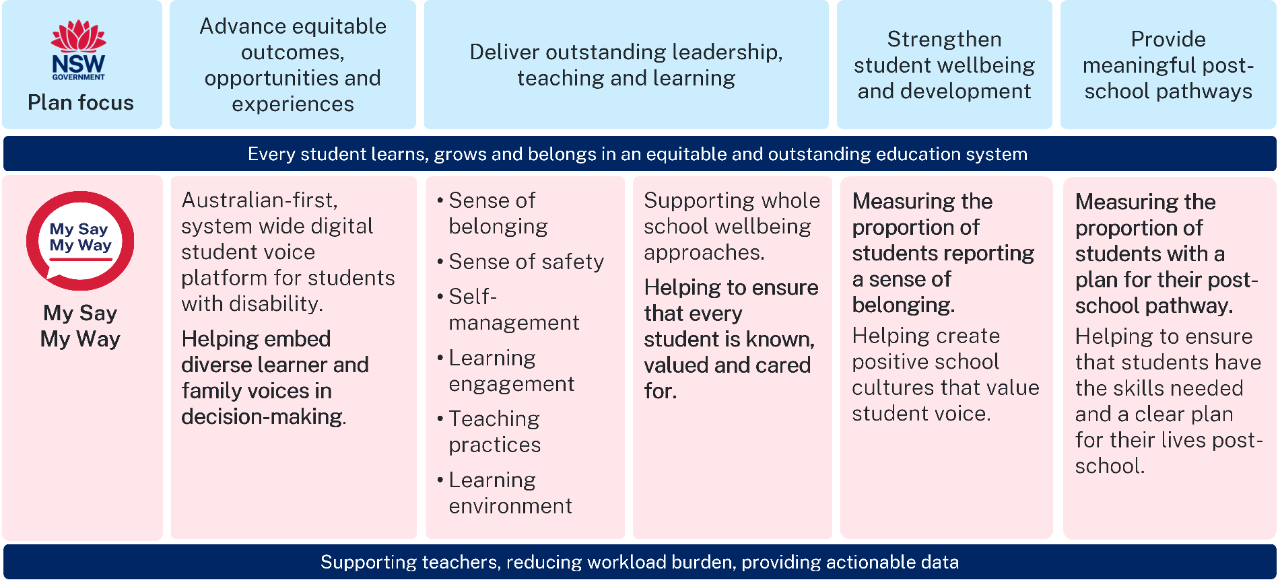
The first principle of inclusive practice is for student agency and self-determination. MSMW puts this into practice by helping ensure that:
- Students have a voice and are supported to express their views.
- Parents/carers are engaged as partners in supporting student voice and participation.
- We use feedback from students to drive continuous improvement in schools and across the system.
Benefits of MSMW
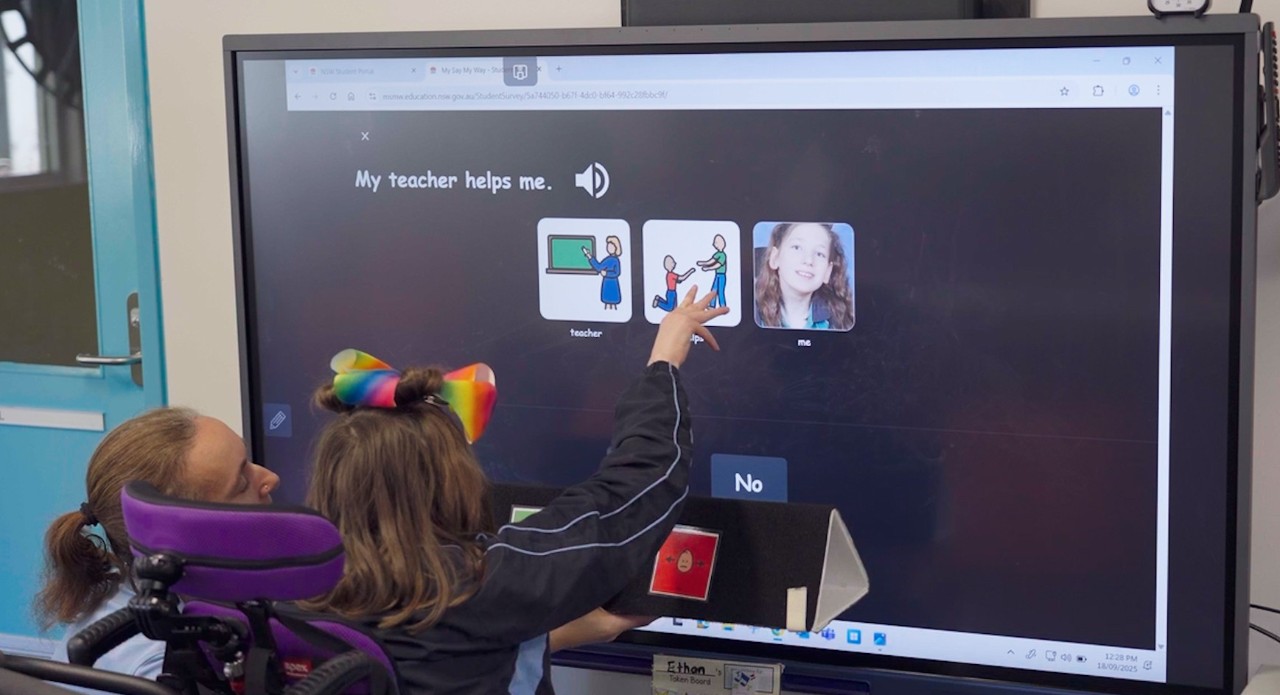
- Students with disability can have a voice in ways comparable to their peers participating in the NSW Public Schools Survey in mainstream settings.
- Teachers can review data for both individual students and whole class groups to help inform wellbeing goals and learning plans.
- School leaders can use the data from the tools to inform whole school reflection and planning.
Future research activities and publications
Our vision is for every NSW public school student with a disability to have the opportunity to share their voice.
Throughout Term 2, we will be working with schools to collect valuable data for survey validation and ensuring that the tools are fit for purpose.
We will also work with schools to develop case studies showing MSMW implementation in different contexts.
We look forward to providing a preview of these case studies at the upcoming SEPLA-CON 2026 conference in July, before making them available to all schools as part of the full roll out in 2027.
Last modified date
24/03/2026
Business unit contact email
-
Executive director
Jacqueline Hodges, Silva Hiendra
Executive director’s business unit
Education and Skills Reform